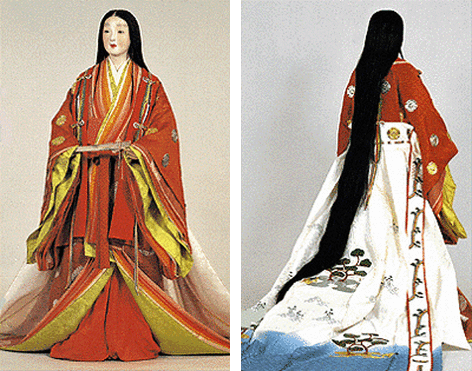
 The Heian Period of Japan from 794 to 1185 AD, was one of fashion oriented sophistication as it was an era of cultural blossoming in Japan. The nation was at peace and the time period is named of the capital Heian, now the city of Kyoto. The Heian Period is considered the height of classical culture in Japan. A world renowned tale, also known as the first novel written is: The Tale of Genji by Murasaki Shikibu, a noblewoman of the Heian court. The Tale of Genji reveals the status of women in court affairs at the time and that of men. The novel also makes clear the balance of gender relations. Noble women, protected by the court were to study the fine arts and this time period produced some of the world’s best female writers. Though women were not encouraged to participate directly in governance. For the most part, the men governed and lead in affairs while women, though allowed solid educations, were not enabled to be of political power. The Tale of Genji is sardonic and at times near scathing toward the shallowness of human nature. Yet, it is incredibly elegantly written and reveals much about court life at the time. Genji is the son of Emperor Kiritsubo by a lesser woman of the court known to be the emperor’s favorite. She is beautiful and bullied by the other women as, because she is favored, she lessens the chances of the other womens' children position in court. It is interesting, that it does not seem that the women are competing to be the emperor's favorite for their own protection directly. All the women, in relations with the emperor are protected by the court according to degree. It is the position of the womens' children within the court system that is at risk, according to the favor of the emperor. In certain ways, Genji is born the male version of his mother, and is spoiled for his beauty and charm as much as she was punished for hers. His mother dies, because of the evils the people of the court were always placing upon her. Genji grew to have many affairs and a few children. He was technically an imperial officer, but little was written of his duties, either due to him not really having any or else, if he did, Shikibu was unable to write of them due to her gender. Genji spends his time writing simple and symbolic poems based on the world of nature, to the latest woman he is interested in, and basing his next move on the style and manner of her reply. Her handwriting, the type of paper she uses, as well as the words of the poem in direct right would all be noted by Genji. Once he receives her reply Genji would go about picking out the proper style of paper to express his mood based on the words he would reply with. Among his recipients, is the Lady of Rokujo, the sad, sweet forever waiting, Lady of the Orange Blossoms, the peasant girl, Lady Fujitsubo, (who is essentially Genji's mother in law) and so many others. Lady Aoi, Genji's wife, is loved by him in a conceivably abstract manner, though really, not at all. She is a beautiful, simple, and dignified woman, who puts up with Genji, with inner rage cooled by social constraints. Lady Aoi, has Genji's child, and dies shortly after to be incredibly grieved by a court that never particularly noted her presence when she was actually alive. Though, Genji is always made even more handsome by his grief. Sadness is the main beautifying element of the novel. The words of the novel itself end in a summation point which perfectly embody the persona of Genji. It is a tale of the lives of people, as they happen to be born into this world; a place of poetry, couplings, sadness, and joy. And it all was of such meaning, except for that it was never of moment at all. This dichotomy of life reflected by Genji's personality, is absolutely brilliant for the first novel written. It is born from a perspective, though objectively written, of a very personal nature. For what more really is there, within the life of the average man (at least the average player)? For The Tale of Genji things really are entirely, except for they are never at all. And the entertainment value within this dichotomy is certainly timeless. The tale was written during an era when fashion and the importance of dress in communicating hierarchy are time consuming and noteworthy processes. Women of the court wore up to twelve inner and outer layers of cloth. Their faces were painted white, their lips pouty, and natural eyebrows were singed off. The natural eyebrows were replaced by gray ones drawn on and arched near the hairline. Also, teeth were blackened, as the effect was considered more lovely than yellowed teeth upon a whitened face. The clothing was meant to be reflective of the seasons and women were to have full faces, signifying wealth, though figures were hidden by the layers of cloth. The womens' hair was worn extremely long. The Heian Period, lead to a sharply contrasting Kamakura period, during which militaristic rule settled over the previous widespread court rule based on code. The pathos of the times changed as did the fashion sensibilities, leading to much more simplistic kimono type wear with lessened adornment. By Sarah Bahl Image: http://people.cohums.ohio-state.edu/bender4/eall131/EAHReadings/module02/m02japanese.html |
Archives
June 2017
Categories
All
|
 RSS Feed