|
By Xin Wen When Louis XV was still alive, and when Marie Antoinette as a young dauphine was still popular among French people, she once wore men’s breeches and a riding coat. The audacious outfit gave her the fame of ‘the only man of Bourbon’. In fact, only after the revolution broke out, did she act as a political figure. At first she refused to leave France and then she wrote letters to her relatives in Austria with the hope that they would rescue her and her family. However, this time she was out of luck. After a very short stay in the Tuileries, in August 1792 she and her family were transported to the Temple, where they were captivated as prisoners. The royal family’s life in the Temple was filled with indignities: one of the queen’s valet recalled that the guards of the Temple even put their hats on in order to express their disrespect when they saw the royal couple. As for clothing —Marie Antoinette’s wardrobe shrank greatly: with the small amount of money the Commune de Paris gave, she ordered ‘two white bonnets, nine gauze and organdy fichus of varying sizes, one skirt, one white linen capelet, one black taffeta capelet, and three lengths of white ribbon, several shifts made from linen and muslin…’ (Caroline Weber, 2006, Queen of Fashion, page 255) Let us not forget this was a woman who used to purchase more than 300 new outfits a year, a woman who spent thousands of livres to comb her hair into a series of new styles, and a woman who was imitated by all the aristocratic women in France. However, when ‘the only living creature in France who still cried “Long live the King!” was a parakeet’ (Caroline Weber, 2006, Queen of Fashion, page 259), the crowd with admiring glances disappeared--partly because they were blocked by the tall, thick walls of the Temple, partly because they didn’t care anymore. After her husband was executed, Marie Antoinette wore a black mourning gown day after day for two months. Her body condition got worse because of the abominable environment of her cell; her hair became white as her trials went on. She was steady and calm in front of most of her charges; however, she couldn’t remain silent when she was accused of ‘incest’—having a sexual relationship with her son—then a 7-year-old boy. Though hard to believe, the aggressive revolutionists indeed invented this absurd accusation. Maybe they thought for a chief culprit who relentlessly depleted the French national treasury (though actually France’s aid for America also contributed to the depletion of the French national treasury), the charge of incest was something she deserved. On the morning of October 16, 1793, Marie Antoinette changed into her last outfit—a white chemise with the stare of a gendarme. This scene reminded me of the stripping ceremony she went through 23 years ago. Over these years she failed as a queen, but succeeded as a fashion example. In Caroline Weber’s account: ‘She slipped into her plum-black shoes, a fresh white underskirt, and her pristine white chemise. To complete the ensemble, she put on the white dishabille dress Madame Elisabeth had sent her from the Temple and wrapped the prettiest of her muslin fichus around her neck. Marie Antoinette’s final fashion statement eloquently condensed her complex sartorial history into a single color with a host of different associations: white.’ 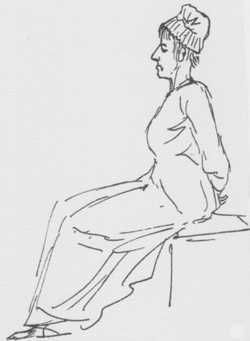 Marie on her way to her execution, by Jacques Louis David
According to Stefan Zweig, only one person was truly woeful after Marie Antoinette’s death: her lover from Sweden—Mr. Ferson. He could never forget the glamour and radiance of the Austrian lady. However the turbulent wave of history did not have the leisure to mourn an evil queen’s death, or an old man’s misery. It took 22 years until people identified the corpse of Marie Antoinette among hundreds of dead bodies. Sarcastically, it was a piece of cloth that led the searchers to Marie Antoinette, in Zweig’s words: ‘A moldering garter enabled them to recognize that the handful of pale dust which was disinterred from the damp soil was the last trace of that long-dead woman who in her day had been the goddess of grace and of taste, and subsequently the queen of many sorrows.’ References : Stefan Zweig, <Marie Antoinette>, Pushkin Press, 2010 Caroline Weber, <Queen of Fashion>, Henry Holt and Company, 2006 The sketch came from Wikipedia. Comments are closed.
|
Archives
June 2017
Categories
All
|
 RSS Feed