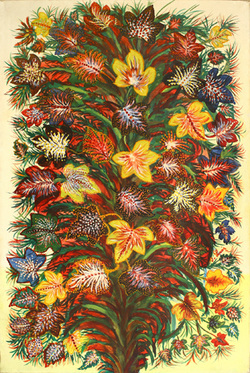
 Seraphine, Feuilles D'automne 1928-30 Seraphine, Feuilles D'automne 1928-30 Séraphine (directed by Martin Provost), recently screened at the French Embassy is a movie about the triumph of human character over circumstance. The story begins with a woman hunched over, collecting mud and water from a pond. She wears a blue shawl. Her body is dowdy, and her dress shapeless. She hums to herself and looks about her with adorable, inquisitive blue-grey eyes. She likes to sit in a tree and smell the air with the breeze blowing her forever unkept hair about.
This is Séraphine, a servant for patrons in a fairly small town at the dawn of World War I in France. She manages, despite the plethora of errands she runs during the day, to paint. And paint she does. By creating mixtures out of nature and some bought supplies. Some stolen, as well. However she needs to paint, she does. She sings to herself as she paints, much to the non-entertainment of the dwellers one floor below her. She is lovable, weird, as awkward as she is natural, and very, very much herself. One of the tenants, Wilhelm Uhde, is renting a flat from Séraphine’s mistress. Uhde is a frontrunner in the art world and a well noted critic. He takes a liking to Séraphine and she to him. She lets him know she paints and the word of Séraphine’s exploits travels to her mistress; who of course, demands to see Séraphine’s work, only so she can mock it and tell Séraphine to give up. The mistress’s son, stands up for Séraphine’s work, and keeps his mother from throwing it away altogether. The piece is laying to the side on the wall in the dining room, when it is noticed by Uhde during a dinner. He demands to know who the painter is and the mistress reluctantly has to admit that it is Séraphine. Uhde becomes Séraphine’s patron and protector. He has to encourage her to sell her work and she seems reluctant because she is afraid of losing her place. Of breaking with the traditions within her own life of servitude. But Uhde convinces her and she agrees to exhibit and sell her work. It is a “pure” relationship as Uhde informs Séraphine that he will never marry a woman in his life. Uhde has to leave France as the War progresses but comes across her work at a local show many years after the War has ended. The two strike up a relationship once more and Séraphine’s art sells as part of what is known as the naïve genre. She continues to paint, but her relationship with Uhde is strained due to her spending habits. She spends more than is coming in and on the oddest things. Such as a wedding dress, when there is no actual wedding. Séraphine’s eccentricities descend into a sad outright madness. She dons her wedding dress and by herself in bare feet, walks through the town knocking on doors and leaving empty silvered candleholders on the doorsteps. At the top of the town stairs are local authorities, waiting to take Séraphine away, in a van. She seems to know why they are there and submits without any confrontation. She just gets into the van, barefoot and in her beautiful dress. The cinematography throughout the film is breathtakingly clear, as if to reflect the purity of Séraphine’s soul and intentions. Uhde attempts to visit Séraphine, but she is too far gone. He makes her more comfortable, by buying her a place in a home where she can be alone. And the final scene is of Séraphine, sitting down on a chair in the middle of a field by herself under a large, comforting tree. Séraphine had the courage to tell a story of a world that begins and ends within herself. She became known as Séraphine of Senlis. It is still not known exactly how her paintings were made. They are of fruits and trees, as if in a child’s dream. By Sarah Bahl The image is from madamepickwickartblog.com 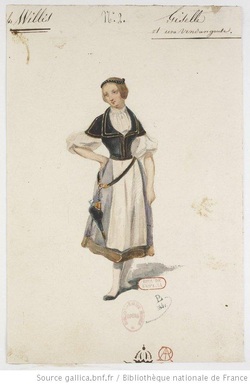 A rendition of Giselle (1841) A rendition of Giselle (1841) To escape to the Kennedy Center in morbidly hot weather is a gift of itself. The plush red carpet is comforting and the hum of persons being shuttled in an orderly fashion to their seats is part of the veneer. Giselle being performed by the Paris Opera Ballet at the Kennedy Center is a gem to see. According to, La Maison Française’s information letter, the Paris Opera Ballet has not been to the Nation’s Capitol in 19 years. The ballet runs through the 8th. The First Act of the story begins with bright and natural woodland scenery. The floor is kept a simple wood and the costumes are elegant and rustic to reveal the simple peasant Giselle (danced by Isabelle Ciaravola). Her dress adds to the quaint rhythms of the peasants' motions as they celebrate the harvest. There are two men in Giselle’s life. One who she accepts and the other, she keeps at a distance. Her preferred man is Prince Albrecht of Silesia, who, tired of court life decides to dress as a peasant and woo the lovely and innocent Giselle. Her jealous suitor, the Gamekeeper Hilarion, unmasks Prince Albrecht, and in doing so reveals Albrecht to be already engaged to the noblewoman Bathilde, (dressed in highly refined and lushly embroidered costume to starkly contrast with Giselle being herself.) The sensitive Giselle dances to reveal her confusion and pain. She dies from the pain of her lost love and the competing men nearly duel over her. 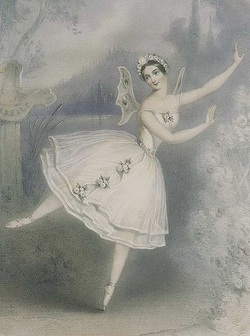 Carlotta Grisi as Giselle (1841) Original Source Unknown Carlotta Grisi as Giselle (1841) Original Source Unknown The Second Act, is absolutely beautiful in an otherworldly manner, with a darkened woodland scene, as Giselle, now deceased has joined The Wilis, the spirits of young women, with the misfortune of death brought upon them before being wed. The dancers, in white spirit garb, are all the same height, and dance in unison to celebrate their current fate within the black woodland night.
The Wilis enact revenge for their broken hearts by wooing young men into their world, never to return. Their first victim is Hilarion. Then, it would be Albrecht, as well, except Giselle convinces the other spirits to let him go, because she still likes him so much. And so the story ends. Giselle returns to her world and Albrecht remains within his own, much as it all began. The original costumes represented are by Paul Lormier, for the ballet’s initial 1841 production. At the time, Romanticism was in high fashion among the general populace in France and the costumes and ideals behind the ballet marketed to this particular niche. Lormier did much historical study to create as realistic a garb as possible. The current costumes represent the spirit of his work. By Sarah C. Bahl By Xin Wen In the Mood for Love is a film made by a Hong Kong director Kar Wai Wong. This director was famous for not having a script. When shooting In the Mood for Love it is said that the crew moved from Beijing to Macau because the authorities asked Kar Wai Wong to show them the full script, but he did not have one. Though the shooting did not follow an actual script, the atmosphere in the film was beyond compare: romantic, elegant, oppressive, and passionate. People who were familiar with Kar Wai Wong knew that the storyline was never his focus—in this case, it was pretty simple too: a man (Tony Leung) and a woman (Maggie Cheung) were neighbors, and they both discovered that their spouses were having affairs. They were friends at first, but as time went by they became close and did not know exactly what their relationship was… 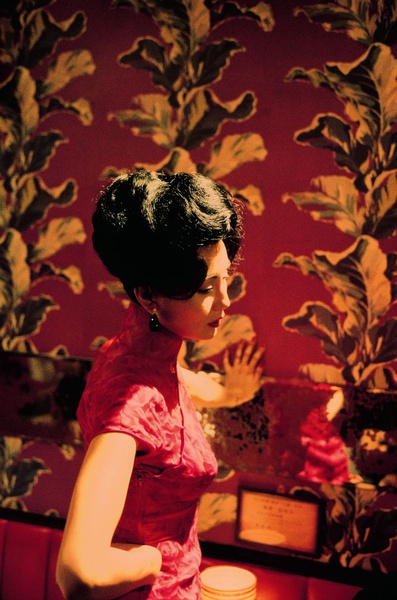 The dresses by William Chang Apart from the original sound track of this film, which by the way is fantastic, the Chinese dresses wore by Maggie Cheung were the most eye-catching scenery. To reconstruct the exact kind of Cheongsam from 1950s, the art director William Chang and the director Kar Wai Wong extracted over 300 old film clips within which the actresses were wearing Cheongsam. William Chang even took some premium cloths out of his personal collection and contributed them to the costumes of the film. Together with a few experienced retired tailors from Shanghai, William Chang made 46 pieces of fine Cheongsams for Maggie Cheung. Though some of them did not survive to the final cut, we can see the beauty of them from a few snapshots here. 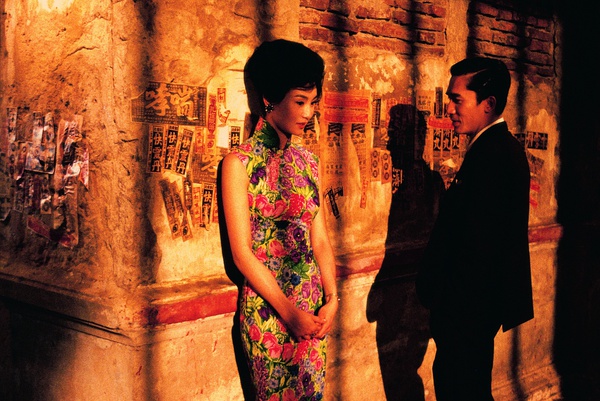 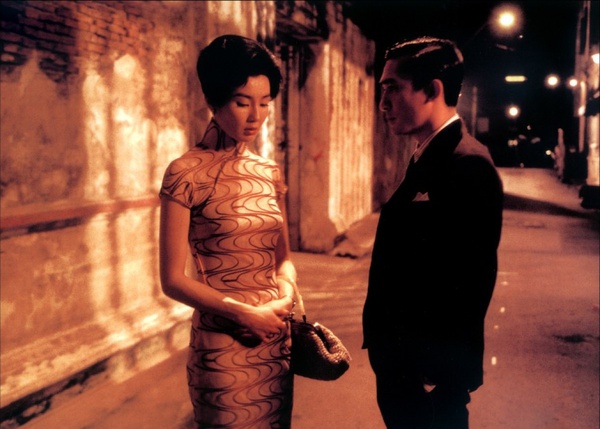 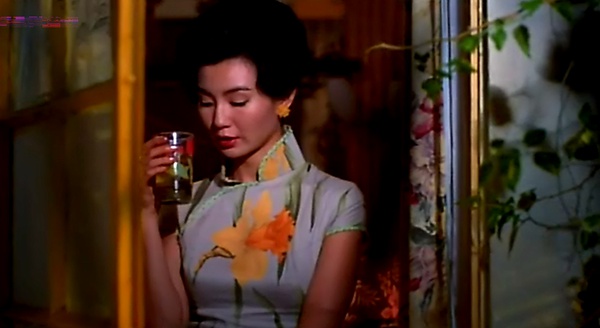 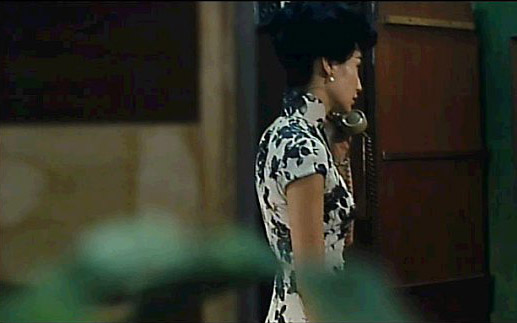 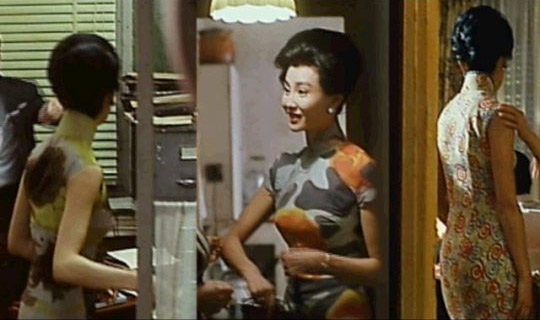 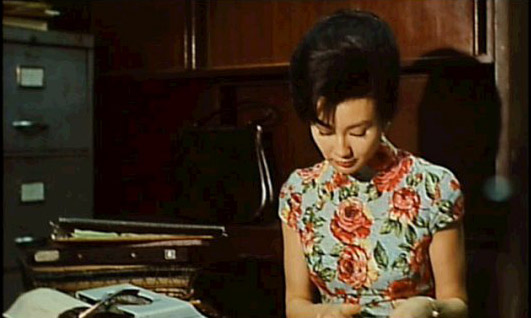 The history of Cheongsam You must have noticed that the Cheongsams Maggie Cheung wore were extremely tight, but actually Cheongsam as a general kind of clothing worn by the noble class of Qing Dynasty, was baggy and loose. The reason led to this is that Qing Dynasty was built by a minority group; Qi people—whom used to live in the north-east part of China and usually rode horses to fight or to travel. For the convenience of riding horses gradually their clothes adopted a loose-fitting one-piece dress style. After Qi people dominated the country, they popularized their Cheongsam to ordinary Chinese people in other regions of the country. The appearances of Cheongsam for women did not change much during nearly 300 years of Qing Dynasty. It was until Xinhai Revolution that it changed its style—the sleeves were shortened and the overall piece was fitting. In Shanghai, during the 1920s, the modern style of Cheongsam emerged and became the favorite of upper-class Chinese women. As the rise of womens’ position in the society increased, women were allowed to wear clothes that revealed their body curves. Of course today Chinese women can wear whatever they want, but the freedom to choose was not always there. References: http://www.imdb.com/name/nm0151858/bio http://en.wikipedia.org/wiki/Cheongsam http://www.imdb.com/title/tt0118694/ Pictures came from www.douban.com by Xin Wen Recently the death of Bin Laden brought my thoughts back to WWII. Though lasting for over ten years, the war on terrorism has not caused as much trouble as WWII did for ordinary people in America. Even if you include the ‘taking-off your shoes’ inconvenience happening at every American airport, the trouble nowadays can not compare with that of seventy* years ago. For countries that were involved in the war, since all the goods and materials had to be used preferentially by frontline people, there were severe shortages in home front. As a result, rationing system was established in both Britain and America. People were giving coupons to buy daily necessaries. According to Lauren Olds’ Constructing the Past: ‘First the British and later the American governments passed bills limiting fabric usage and rationing clothing items. In 1941, each British adult received 66 clothing coupons, but this number quickly dropped to 48. In 1945, each person received only 36 coupons.’ If you think you can buy 48 pieces of new clothes with 48 coupons, then you are completely mistaken: because ‘a woman’s tweed suit alone cost 18 coupons, half of the yearly ration.’ In 1942, the War Production Board in America set several rules concerning textile and clothing: such as-- ‘jackets could not have more than two pockets; an evening dress could not be made of wool cloth; or people can barely add any attachments on a dress.’ The impact of these regulations on fashion was dramatic: for example, the two-piece bathing suit for women came into being because U.S. government said the fabric used in women’s swimwear had to be reduced. 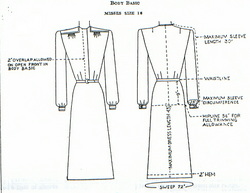 Faced with shortages, designers and consumers accommodated their aesthetic tastes to tough circumstances. On the designer’s side, (in Lauren Olds’s words): ‘because rubber was necessary for the war effort, designers promoted styles that did not require girdles.’ On consumers’ side: since nylon stockings were unavailable at the market, ladies painted their legs to pretend they were wearing stockings—some even used black eye pencil to draw “seams”. Governments also tried very hard to persuade civilians to make full use of their current wardrobes. A booklet called <800 Ways to Save and Serve or How to Beat the High Cost of Wartime living> contained many handy tips: such as buy more cotton clothes since cotton is cheaper and hard to wear out; or buy fabrics that are tightly woven. During the WWII, austerity was the key word. Women clothes during war time were indeed simple and practical, after all Rosie the Riveter can not wear feminine gowns to work. However, new designs emerged during war time. According to the research of Lauren Olds, ‘keyhole neckline’ as a new design first appeared in 1941. Apart from this, ‘the variety of ladies hats during the war is also evident…there are hats with wide brims, small caps that rest on the back of the head, and many other unique, fanciful designs.’ In 1945, the war ended. However the haze hovering fashion world did not disappear until the year 1947—when Christian Dior introduced his ‘New Look’. With plenty of fabrics and cloth, women rebuilt their elegant images with long gloves, wasp-waisted silhouette, full-length skirts and high heels. The skirts alone used as much fabric as 10 or even 15 wartime skirts, some using as much as 30 yards of fabric! (Lauren Olds.) Within ten years, rationing, coupons and scarce nylon stockings seemed forgotten by the same generation. Some people said the drabness and uniformity of womens’ clothes during wartime manifested the patriotism of women. However, comparing with the actual sacrifices female soldiers made during WWII, obsolete or stale clothes were only pieces of cake. Dior----New Look, 1947 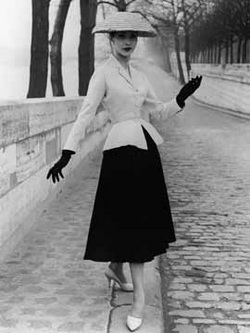 References:
http://www.fabrics.net/joan702.asp Olds, Lauren (2001) “World War II and Fashion: The Birth of the New Look,” Constructing the Past: Vol.2:Iss.1, Article 6. Pictures come from: http://www.fabrics.net/joan702.asp http://brilliantlybritish.blogspot.com/ *correction made as update-S.B. By Xin Wen When Louis XV was still alive, and when Marie Antoinette as a young dauphine was still popular among French people, she once wore men’s breeches and a riding coat. The audacious outfit gave her the fame of ‘the only man of Bourbon’. In fact, only after the revolution broke out, did she act as a political figure. At first she refused to leave France and then she wrote letters to her relatives in Austria with the hope that they would rescue her and her family. However, this time she was out of luck. After a very short stay in the Tuileries, in August 1792 she and her family were transported to the Temple, where they were captivated as prisoners. The royal family’s life in the Temple was filled with indignities: one of the queen’s valet recalled that the guards of the Temple even put their hats on in order to express their disrespect when they saw the royal couple. As for clothing —Marie Antoinette’s wardrobe shrank greatly: with the small amount of money the Commune de Paris gave, she ordered ‘two white bonnets, nine gauze and organdy fichus of varying sizes, one skirt, one white linen capelet, one black taffeta capelet, and three lengths of white ribbon, several shifts made from linen and muslin…’ (Caroline Weber, 2006, Queen of Fashion, page 255) Let us not forget this was a woman who used to purchase more than 300 new outfits a year, a woman who spent thousands of livres to comb her hair into a series of new styles, and a woman who was imitated by all the aristocratic women in France. However, when ‘the only living creature in France who still cried “Long live the King!” was a parakeet’ (Caroline Weber, 2006, Queen of Fashion, page 259), the crowd with admiring glances disappeared--partly because they were blocked by the tall, thick walls of the Temple, partly because they didn’t care anymore. After her husband was executed, Marie Antoinette wore a black mourning gown day after day for two months. Her body condition got worse because of the abominable environment of her cell; her hair became white as her trials went on. She was steady and calm in front of most of her charges; however, she couldn’t remain silent when she was accused of ‘incest’—having a sexual relationship with her son—then a 7-year-old boy. Though hard to believe, the aggressive revolutionists indeed invented this absurd accusation. Maybe they thought for a chief culprit who relentlessly depleted the French national treasury (though actually France’s aid for America also contributed to the depletion of the French national treasury), the charge of incest was something she deserved. On the morning of October 16, 1793, Marie Antoinette changed into her last outfit—a white chemise with the stare of a gendarme. This scene reminded me of the stripping ceremony she went through 23 years ago. Over these years she failed as a queen, but succeeded as a fashion example. In Caroline Weber’s account: ‘She slipped into her plum-black shoes, a fresh white underskirt, and her pristine white chemise. To complete the ensemble, she put on the white dishabille dress Madame Elisabeth had sent her from the Temple and wrapped the prettiest of her muslin fichus around her neck. Marie Antoinette’s final fashion statement eloquently condensed her complex sartorial history into a single color with a host of different associations: white.’ 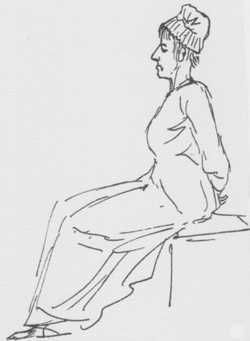 Marie on her way to her execution, by Jacques Louis David
According to Stefan Zweig, only one person was truly woeful after Marie Antoinette’s death: her lover from Sweden—Mr. Ferson. He could never forget the glamour and radiance of the Austrian lady. However the turbulent wave of history did not have the leisure to mourn an evil queen’s death, or an old man’s misery. It took 22 years until people identified the corpse of Marie Antoinette among hundreds of dead bodies. Sarcastically, it was a piece of cloth that led the searchers to Marie Antoinette, in Zweig’s words: ‘A moldering garter enabled them to recognize that the handful of pale dust which was disinterred from the damp soil was the last trace of that long-dead woman who in her day had been the goddess of grace and of taste, and subsequently the queen of many sorrows.’ References : Stefan Zweig, <Marie Antoinette>, Pushkin Press, 2010 Caroline Weber, <Queen of Fashion>, Henry Holt and Company, 2006 The sketch came from Wikipedia. |
Archives
June 2017
Categories
All
|
 RSS Feed