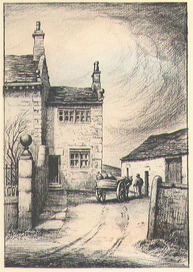
 The Old Manor House, Haworth The Old Manor House, Haworth Agnes Grey, by Anne Bronte, is a quintessential ode to upper middle class life. Agnes is one of two daughters born into the odd coupling of a spirited squire-man's daughter and a clergyman within the countryside of Northern England. "Of six children, my sister Mary and myself were the only two that survived the perils of infancy and early childhood." Agnes continues to describe her childhood as one of protected sensibilities, as "father, mother and sister, all combined to spoil me - not by foolish indulgence to render me factious and ungovernable, but by ceaseless kindness..." 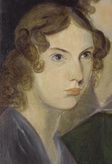 The glass globe of the Grey's family life is shattered, when Agnes's father, bent on securing a more formidable family fortune gives all the household income to a passing ship merchant, who promises to return to the family double the investment. Agnes must then leave her family encompassment of endless compassion, as she knows it, to protect herself and them in her father's financially related absence, because the family's fortunes had sunk into the ocean along with the merchant himself.
Agnes and her sister had spent many a happy hour traversing the moors; dreaming of what the riches could bring them. And when news of the sunken ship enters the family, Agnes's father, "was completely overwhelmed by the calamity." Her sister, Mary, is similar to the father and more of a moody and delicate nature. It is up to Agnes and her skill set to repair the family's station, or at least keep them from imploding toward the poorhouse, which was not uncommon to happen to families during the Victorian period. So, Agnes begins the type of work befitting for an unusually well educated, as well as highly bright, middle class girl. She hires out as a governess and enters the world of psychological abuse according to the standards of creepy rich people. (No one captures psychological abuse quite like the Bronte sisters). For the sake of exemplification, shall we begin with her less than lovely charge Tom and his equally deviant sister Mary Ann? " 'I observed, on the grass about his garden, certain apparatus of sticks and cord, and asked what they were. 'Traps for birds.' 'Why do you catch them?' 'Papa says they do harm.' 'And what do you do with them, when you catch them?' 'Different things. Sometimes I give them to the cat; sometimes I cut them in pieces with my penknife; but the next, I mean to roast alive.' 'And why do you mean to do such a horrible thing?' 'For two reasons; first to see how long it will live - and then, to see what it will taste like.' " The parents of these odious beings insist they simply need a firmer governess, though Agnes is not allowed to discipline them. She is relieved of her post after several months with the family. But she soon hires out again to the Murray family, with abilities to teach music, singing, drawing, French, Latin and German. She remains with the next family for years and is witness to their cold unfeeling world and all its wasteful sadnesses. Agnes is also given the conundrum of having to tutor children who hate to sit down to learn anything and recite Latin while staring out the window, not caring what anything they are learning about means. Agnes values education greatly and is forced to try to share her world with charges who have no sense of value nor attention span. The two Murray daughters, Rosalie and Matilda, tell whatever lies they feel like to men interested in Agnes, as god forbid Agnes should have a man love her. But eventually Agnes does marry (after the Murray children are grown) and happily so. Her husband is not rich, but she and her husband are friends. They are also never in want and even have enough to put a little aside for the children every year. By Sarah Bahl
1 Comment
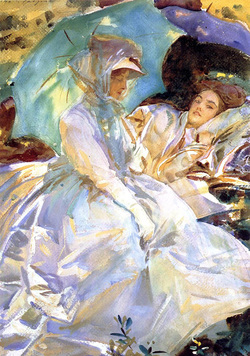 Simplon Pass: Reading by Sargent Simplon Pass: Reading by Sargent The Wings of the Dove by Henry James is the story of Kate Croy, the contemporary London female of the late 19th century, of the upper classes yet with a minimal income, since the death of her mother. Her father, Lionel Croy notes his daughter for her beauty and cognitive merit. But does not love her in the least for any of her finer qualities. Kate is simple, of fine proportion, and known by her friends to be clever. Of her father, those who knew him said, "how he does dress!" those who knew him better state, "how does he?"
The family's fortunes seem to be in the hands of women. Kate is granted an inheritance by her recently deceased mother, that she agrees to share with her widowed and overburdened sister; Marian. The inheritance is not enough for both Kate and Marian to live on forever so it is agreed Kate should be taken in by her Aunt Maud until she finds a suitable marriage arrangement, but it is all to be sufficed upon one agreed condition. Kate is to give up her father. Despite that Lionel is the reason for the Croy family's current representational and financial floundering, Kate asks him to refuse her Aunt's request. Lionel does not because, "What he couldn't forgive was her dividing with Marian her scant share of the provision their mother had been able to leave them. She should have divided it with him." And so Kate returns to her Aunt Maud and her financially conditional world where, "there were always people to snatch at you and it would never occur to them that they were eating you up. They did that without tasting." Kate visits her sister to discuss their affairs as they are comrades in a lost Serengeti of apathetic survival. Marian, with greasy children, who had grown near fat and was a consummate widow. A verily named Mrs. Condrip who was now a faded icon of her husband's existence, "She was little more than a ragged relic, a plain prosaic result of him as if she had somehow been pulled through an obstinate funnel, only to be left crumpled and useless and with nothing in her but what he accounted for." The image of Mrs. Condrip is what is at the heart of Kate's dilemma: What are her choices? Her boyfriend, Merton Densher is conceivably likable but of no substantive purpose nor fortune. Densher has a Cambridge upbringing and is known in finer circles, but does not have the financial backing to provide for Kate, Marian and Marian's family. And Kate knows that if she marries Densher on his fortune alone, she could become her sister. Aunt Maud is the power presence with both Kate's and Densher's lives. Aunt Maud is the representational matriarch, the keeper of the bread, the ultimate holder of any opinion. Upon such a scene enters Milly Theale, the prodigious American with pure red hair, who was striking in beauty, but of an unusual sort. Milly comes to Europe with a companion, Mrs. Stringham, a financially independent writer, and joins Kate's circles. At first the games played are with Kate and her lovers by Milly but the tide turns on Milly as Kate knows of one thing that can tilt the board in her fortune: Milly is dying and rather quickly of a wasting disease of unknown detail. Kate attempts to set her lover, Densher up with Milly, to cause Milly to fall in love with him so they can have Milly's fortune post her demise. But Kate wielded Densher upon the chessboard in an unusual fashion: she pushed him, the pawn ahead and he became a queen. He could now move in whatever direction he willed, as Milly's death freed him on many levels of social stance and financial merit. He also had fallen in love with Milly in earnest. The Wings of the Dove title could be an allusion to The Bible, Psalm 55 (or to Psalm 68:13) the infinitely suffering infinitely gentle creature to fly away and be at rest away from the horrible condition otherwise known as friends. But really, the irony is the title could be nothing but pure sarcasm. There is no dove in the entire novel. It is darker even than the ideal of a singular innocence tolerating the world of the wicked and living on hope of a better breath somewhere. There is no innocence. One spends the novel searching for this dove. By Sarah Bahl 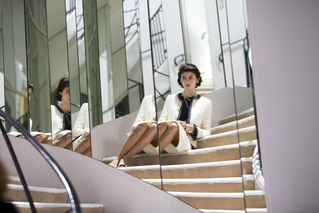 Coco Before Chanel, is a film about the rise of a woman, born into poverty and determined not be another drudge in the system. (Our lead character is a born snob.) The film begins with two girls being driven in a simple peasant cart. It is 1893. They are taken to a nunnery, where the nuns wear incredibly starched wide sweeping black and white head covers, that are essentially enormous fabric triangles on their heads. Even for the nuns, 1893 was not an era of practicality when it came to fashion.
Gabrielle Chanel and her sister Julie, are the two young girls in the cart. They are wordlessly and unceremoniously dropped off by their father for care within the abbey, that served as an orphanage for poor undesired girls and as a boarding house for wealthy young girls. Chanel waited for her father to come back every week while at the abbey. He never did. Chanel and her sister both become pretty women, working as seamstresses during the day and in a pub as singers in the evening. Their dresses are very simple. There is a huge difference in the style and the fabric of how the wealthy women dressed versus the working class women. For example, today, there is not a huge difference in the style, cut, color and detail of a suit Hillary Clinton would wear to work, versus, a secretary working as an administrator in any given office. In the early 1900s, differences in terms of style of clothing when it came to class were of incredible variance. Wealthy women had a marked amount of detail in their fabric, how their hair was done, and the jewels they wore. So much adornment. The working class women wore very simple, clothes of plain coloring, that differed greatly from the garb of the wealthy. At the pub, Chanel meets her lover and protector Étienne Balsan, who she insists on staying with, as she sees him as pivotal to her gateway toward a better life. It is Balsan, who christens Chanel with the name Coco, after a song she sings. The name does seem to suit her tomboyish nature and simple features. Coco, charms Balsan with her quaint mannerisms, her love for clothes, horses, and need to be something different. She is known to dress as a boy, most of the time. To forego the use of a corset and practice other such anomalies for the day. Coco, consistently wants to have more and be more. She realizes she will never have a stage career but the hats she makes are well liked and in demand. She has a knack for sewing. She leaves Balsan, who remains a supportive father figure throughout her life, for Arthur, “Boy” Capel, a friend of Balsan’s. Boy asks Balsan to have Coco for the weekend, which is how their love affair began. It might seem terrible today for two men to share a woman without complaint, but during the early 1900s in Europe it, was considered unseemly for men to rival each other for a woman. And if one man wanted to sleep with another man’s lover or even a wife, the husband in question should consider the offer a compliment, that another man would want his wife/lover. It was the culture at the time. Coco leaves Balsan, because he wants her to be his alone, and to have no other features. He wants her to become his wife and she says no. She wants a different future for herself. Boy is the man who supports her career ambitions. He lends her money to start her own business. With the money to launch her own creations on a consistent basis Coco Chanel leads the world of fashion in two manners. First, she lessens the differences in clothing when it comes to class. Her outfits are simple and chic. Second, she lessens the difference in clothing when it comes to gender. Her boyish, elegant simplicity is trademark of all her fashions. Her ideals matched wide sweeping sentiments toward womens' rights at the time. Chanel lead the world of fashion into incredible changes, that are very visible today. By Sarah Bahl |
Archives
June 2017
Categories
All
|
 RSS Feed