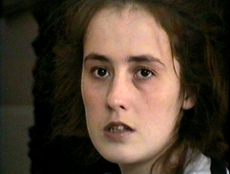
 By Sandrine Bonnaire (2007) gives a multi-tiered view of mental differences and how some of those who need special care are treated by the medical system, their peers, family and caregivers. Sabine, is the protagonist, a woman who was found to be different from her siblings and in need of particular care at a young age. Sabine is autistic and as a 38 year old large figured adult, she sits on a couch of a special home where her head hangs to the side and her mouth stays open with a drool. She is asked by a caretaker if she would like to see the animals. She answers yes but asks that if she sees the animals will it mean she can't go gardening as well. It's a surprisingly well thought out response given her overall expression.
Sabine enters a barn with a caretaker, pets a horse and feeds the animals as instructed. She drools fairly constantly and repeatedly asks to take a break. She is fatigued easily and seems fragile. The scene flips to Sandrine dancing with her sister, many years before. They both look to be in their early twenties. Sabine gazes at the camera, with one eye squinting. She can dance, read and write. She's also barely recognizable as a very thin, pretty girl in a patterned sweater awkwardly and adorably dancing with her father and sister. She was enrolled at school with her siblings, but the tormenting by her peers caused her to self mutilate and within three months she was out of school. She stayed at home with her mother until she was twenty seven. During those years with her family she was both creative and productive. She would make dolls, knit sweaters for the whole family, study English and Geography in her room for hours with books she bought with her own allowance money. Sandrine bought her a piano and with private instruction she was quickly playing advanced compositions by Schubert and Bach. She even composed her own piece, The Path of France The scenes change to Sabine in the garden and not so much gardening as lying down with her back on the grass and her eyes closed, her arms to the side and her legs straight out in front of her. Sabine does not want to move and once propped up by a good natured caretaker lies down again. She seems genuinely exhausted and all her movements are exceedingly sluggish. Somehow she makes it into the house as they are having lunch as a group. Sabine after a couple of forkfuls of food lets out a high pitched screech, twice. She wants to eat with Sandrine but can't as the latter is filming. The difference in Sabine's appearance came after her stay in a hospital when she began to spit and hit her mother. She gained sixty pounds in a few years, began to drool and despite large quantities of oral medication she still hits and spits at times. Sandrine expresses shock at the difference the stay in the hospital had on Sabine. The filmmaker also, by way of theme, questions the efficacy of the medications on the patients. Does it really help them lead more fulfilled lives or does it just make them more ill by depleting the natural intelligence and slowing down the patient? Would Sabine have become worse on her own, with or without medicines? These are questions that are left to the viewer to ponder, as there seems no perfect answer but the feeling that there must be a better way. It also makes one wonder, what of the patients whose families cannot afford such high end care as those in the film receive? Her name is Sabine connotes more from French as "Call Her Sabine." She is a person, a sibling and a friend. By Sarah Bahl 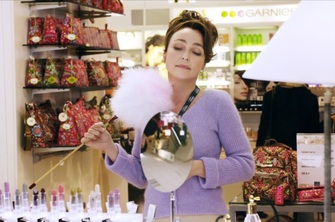 Is a Cinderella story that goes both ways, for what happens when Prince Charming needs to be rescued himself before he can save his Princess? The tale begins to calypso music and in a Belgium shopping mall where a woman wearing dark sunglasses and an expensive black coat with fur trim fingers through the makeup counter with a unique sense of urgency.
Odette, (played by Catherine Frot) an especially pretty middle aged sales associate with auburn hair reveals herself from behind a set of mirrors and asks what she can do to help. The lady removes her glasses to show a bruised eye and says she has a rash. Odette replies; "No problem, I have the right cover for you." And when she attempts to apply it to the lady's bruise, the woman winces and draws away. Odette advises her to get a steak from one floor down to draw out the pain and swelling. The woman insists she wasn't beaten but walked into a door and Odette's response is; "Yeah, sure, I myself walked into many a door when I was in love." The lady walks off with the cover stick and Odette leaps up the escalator steps because "It's time!" Her friend, who wears makeup and works in the books department asks her if today is one of special event, and Odette passes by without saying anything. She changes into a pretty, pink and beige suit (she has lovely clothes - that seem made beyond the working class, but it is a movie and a French one at that). Odette, with her hair done with light brown feathers, stops by the salon where her son is a hairdresser and asks him what he thinks of her countenance. He responds that she's dressed perfectly for a wedding as the mother in law. She starts to feel bad and as she sits down begins to give excuses for why she should just skip the book signing of her favorite author, Balthazar Balsan, whom she has a deep crush on. Her son insists she goes and takes off the feathered piece which does improve the look dramatically somehow. Once Odette is on the bus sans wedding hair thanks to her son, she asks the women, an elderly lady with incredibly pale, clear skin, next to her if this is the bus for Brussels. The lady asks her, "What?" And Odette says, "No, nevermind." The lady asks "What?" again and Odette eventually asks her if this is the bus to Brussels, while she is basically shouting into the woman's bad ear. "Yes, of course this is the bus to Brussels as it is marked so all over. Why? Am I on the wrong bus again?" A moment that is as gently realistic as it is awkwardly comedic. Odette makes it to the book signing but when she meets Balsan, in an hysterical display of social anxiety, she nearly hits her beloved author in the face with her copy. He signs, but as he is asking her for her name, she blurts out, "Dette," and so he signs her book as such. Our heroine is in tears at a cafe over the signing fiasco and there is nare a stranger to comfort her as what can anyone say? But while on the way back on the bus, Odette reads her novel and her embarrassment is forgotten as she floats in the air, rescued by her love for Balsan's words. On her way home while still reading her novel she sees a man dressed early 90s style with long stringy hair and a plaid long sleeved shirt. He has a beard and is sweeping the porch outside of Odette's apartment building. "Ca va Jesus?" she asks. "Ca va," he responds while taking a drag from a cigarette and looking very drugged up. The Jesus character is weaved throughout a film that could do without him. Perhaps his addition is an attempt to add a deeper motive to a romantic comedy, but it would be better without the symbolism of life, death and eternal powers. Some things are best when they are kept to what they are. Odette returns from the signing to her world, where Josephine Baker's songs and Balsan's words are a godsend within her cramped apartment where she lives with her son and daughter, as well as the latter's boyfriend, whose feet stink and who never brings home a penny after tinkering with cars all day. Her favorite moments are of fantasies. Balsan's life with a stunning wife who has a high end education and who looks out of his league, and their open marriage could not be of greater contrast to the adorable world of Odette. When Balsan's world falls apart, as complications from his and his spouse's affairs reach his professional life, he needs someone to understand and appreciate his work. He needs to be saved by a person separate from his current existence. And in this someone he finds Odette. By Sarah Bahl 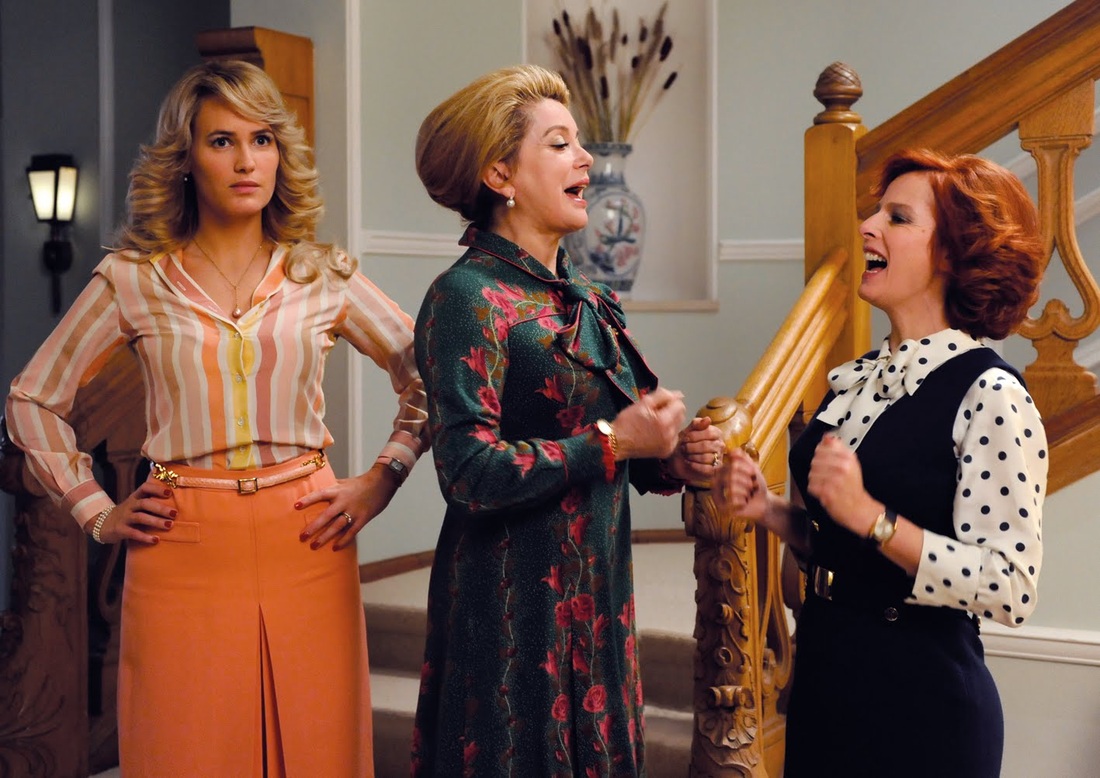 This 2010 French film starring Catherine Deneuve, Gerard Depardieu, Fabrice Luchini, Karin Viard, Judith Godreche and Jeremie Renier; begins with a cheesy 1970s jingle as Suzanne Pujol (Deneuve) jogs in the morning light by beautiful lakeside scenery with her hair in curlers and covered with a net. Suzanne is the spoiled and self defacing housewife of industrialist, Robert Pujol who owns an umbrella factory he received through her dowry. The movie is first set on Suzanne's birthday which is like any other day for her as she goes for her morning jog in her bright red 70s running suit, blows kisses to doves, writes poems about squirrels and nags her husband to take his medicinal drops.
They have breakfast together and Robert, instead of remembering her birthday, reminds his wife her place is not in the kitchen, as she has given the servants the week off. Suzanne wonders out loud to him where her place is. Robert tells her they both must not forget she is Mrs. Pujol, as if she has no thoughts for herself and her thoughts are the same as his. And she says she tells herself everyday, "Je suis Madame Pujol, Je suis Madame Pujol" - yet she doesn't know what her place within that role is. After Robert leaves for work but not before complaining about his workers, Suzanne realizes he forgot his drops and she calls the Pujol- Michonneu factory to have her husband's office wife, Nadege who is the company's top secretary, make sure he takes them. Their brief talk is hilariously awkward. Nadege is upset to find via Suzanne that Robert has been to Badaboum with a so called German buyer and she tells him to get it from his whores at the club. He whines that the place is closed on Thursdays. Joelle, the Pujol's grown daughter, comes to visit Suzanne who is making a bed and fluffing pillows. In honor of Suzanne's birthday Joelle picks a rose from her parents' garden and gives it to her mother. Joelle shares news with Suzanne, who is shocked and saddened to hear Joelle might be divorcing; as her husband, Jean-Charles is always traveling, is not spending time with their boys, and Joelle is afraid he is having affairs. Suzanne encourages her daughter to stay with her husband as sparks may fly again, Joelle's response is, or not, as she cruelly points out Suzanne and Robert sleep in separate bedrooms. Suzanne says sex is not everything and Joelle says, at her age perhaps! Joelle tells her mother, she does not want to be like her; an overly accepting potiche (pretty vase on a shelf). Joelle continues that she thinks her mother is a doormat and women don't have to put up with men's whims in such a manner anymore, it is the late 1970s after all. Robert arrives home to take his drops as he was too busy at Badaboum the night before to take them. His daughter reminds him of his wife's birthday and he is surprised, says he is busy and tells Suzanne to buy whatever she likes. She meekly thanks him. After Joelle leaves, Robert takes his drops but spits them up when his wife says their son, Laurent, is considering marrying Floriane Marquiset. Robert shouts that Floriane is no better than a prostitute, and Suzanne calmly replies that he is being a snob, he doesn't even know Floriane, that her father owns a patisserie and Floriane is accomplished and highly proficient at the piano. Robert does not care about any of this and says Suzanne has no right to an opinion. That she is a spoiled little woman who should be happy with kitchen appliances. Then the phone rings and it is someone to inform Robert all of his workers have gone on strike. He leaves after pondering out loud the cost of the strike to himself and an announcement that he will show all the workers his fists. Suzanne contemplates the strike and then writes a poem about a rose. Suzanne's relationship with Laurent is much more relaxed. She encourages him to study art as he doesn't like political science. He is gentle and conversational. She asks him to tell her about Floriane and then mentions while peeling a carrot how it is too bad Mrs. Marquiset died by electrocution from a hairdryer. Later that evening the family is gathered together, Joelle with her two boys, Suzanne and Laurent, as the adults smoke, eat well coiffed appetizers and drink bubbly alcohol. Robert is not there as Suzanne comments that her husband's whereabouts have become more and more mysterious. The doorbell rings and everyone assumes it is Robert, "J'arrive Papa, J'arrive," says Joelle as she dashes to the door with a cigarette held between her manicured fingers. "Nadege, what are you here for?" Nadege tells her it is urgent and Joelle gestures to an absolutely gorgeous and cultured looking family room. Nadege tells them that yes, it involves Robert and that he has been taken hostage by the workers. Laurent leaves to settle the dispute in a humane manner, but comes back disheveled and with torn clothes as his father attacked him along with giving his son some words of choice. The family is unsure of what to do next, but Suzanne decides to go to the city's mayor, who happens to be her old lover and ask him to intervene in order to quell the worker's rage so her husband may be released. Maurice Babin, otherwise known as Monsieur Deputy Mayor is a man of the people and is in complete contrast to the Pujol's and their lifestyle. Suzanne is also the one who blew him off after their affair and she was married to Robert at the time, but she plays her cards right, Maurice forgives all of this and agrees to intervene. The next morning Robert is at home in bed, with a doctor giving him orders to come to the hospital for tests as he is run down from daily work. Nadege is also still there having breakfast with Joelle and Laurent. She suggests she make a bullion for Robert and Joelle just looks stunned as Laurent politely and awkwardly says, pourquoi pas?; then Nadege dashes about to make her healing broth as if she has been waiting to do so her whole life. Suzanne also, at her husband's request takes over the factory. Robert is too ill and high strung to continue with the work, especially considering the dour climate of the working landscape. She does an excellent job and the employees really like her. Both her son and daughter also serve at the factory under their mother's leadership and it becomes a successful family operation. Though, when Robert comes back from a refreshing cruise in better color and overall health, he wants to take the factory back from Suzanne. He lets her know this at the Pujol-Michonneau home office, after he gives her a lovely gold bracelet in the presence of Nadege. He gives the secretary a present too, of Turkish candies that can be bought at any given international airport. The same as giving one's lover the gift of a wrapped Toblerone in front of one's spouse. Suzanne puts up a fight for control over the factory. She tells her husband he can now be like a lion on a plain, doing nothing all day, but golf and fish. Suzanne does not win her battle for the factory, due to internal family politics, but she does even better for herself in the end, as all the politics Suzanne has up her sleeve come into full force. With Potiche the main perspective of satire is based on how unpure yet sociable humanity really is. Perhaps it is best not to generalize but it seems that in American films, affairs are heartbreaking and treated as scandalous. In French cinema, the affair itself, is not of consideration as much as how far the film may go in originality to mock such a cliche. It is odd that Joelle, should resemble Maurice Babin in looks. And as the story progresses it becomes increasingly apparent that Suzanne is not so meek and naive as she would seem but is simply a more mature version of Robert. The two understand each other in a way no one else could ever know either of them. They remain together based on this bond alone it seems. By Sarah C. Bahl 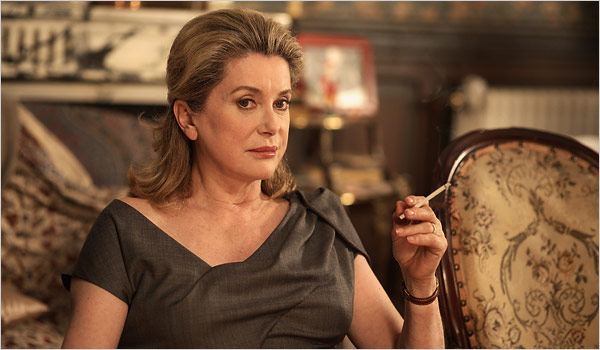 Jean-Claude Lother/IFC Films Is about how the pain of both life and death is made easier to digest in the form of stories. The scene begins at a snow covered funeral where an elderly man gives a eulogy to an imaginary group of mourners. In 1965 Abel and Junon had Joseph, the first born. They also had a little girl, and when Joseph was in kindergarten he developed Burkitt's Lymphoma. The tragedy is not told directly with the watched brutality of a child's illness but in the form of gentle puppets. Neither the daughter nor the parents were compatible with Joseph. In desperation the couple conceives a third child, Henri, but his placenta was also not a match. Joseph died 18 months after the birth of Henri, to make Elizabeth the eldest of what was to be eventually two brothers. The memory of Joseph fades. Years later, when Junon is elderly, yet no less beautiful, she gathers a tray of tea and sweets together in a homey, upper middle class house. But while carrying the tray she drops it to the ground, and the world blurs. She sinks to the floor. The scene changes to Elizabeth speaking to a specialist about the family problems and her own sense of herself to be cold and empty. Elizabeth is a playwright, and her brother, Henri bought her the theater for her to perform her works and they were successful. But, Henri did not pay for the theater in direct right and was greatly in debt. The family members; Elizabeth, Abel and Henri stand in court and Abel agrees to pay Henri's debt. But Elizabeth says she will pay the full sum as long as Henri is banished. The judge finds the agreement to be as tastelessly cold as it is over personal for a courtroom, but since the debt needs to be paid, Elizabeth's terms are accepted. Though Henri is banished, it is not because Elizabeth's life is perfect. Her only child, a son has schizophrenia, an essentially incurable disease. Junon comes back from her doctor's appointment to tell Abel, between puffs of elegant cigarette, that she has cancer, though it is curable with a bone marrow transplant, but the transplant could cause a reaction whereby the body basically freaks out at the unknown marrow and starts attacking itself. In the end, it is the inutile Henri who is the match for Junon as well as Elizabeth's son. Junon chooses Henri and the family is brought together for a functionally dysfunctional Christmas, with lots of wine, a children's play and a renegade trip to Midnight Mass. By Sarah Bahl 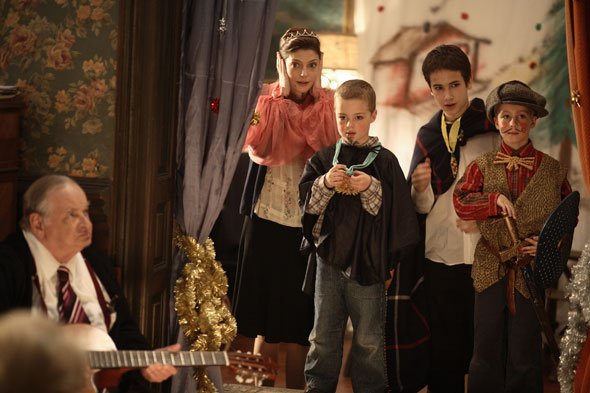 From KBPS 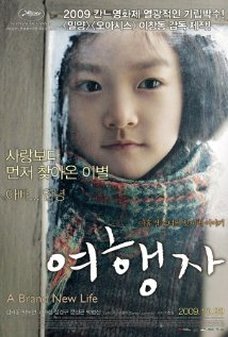 After a lovely evening at the Korean Cultural Center celebrating the work of the Peace Corps, I've thought to share the story of A Brand New Life by French-Korean filmmaker Ounie Lecomte. The film is made into a gentle, naturally occurring montage with little music. It begins with an adorable girl riding on the front of a bike with her father. She inhales happily. She puts on new black dress shoes. Her name is Jinhee. She and her father have dinner together and she sings him a song. "You'll never now how much I loved you. You'll regret it one day when time has passed." It is 1975 and a bus near Seoul pulls over and Jinhee gets out. She is told by her father to hurry and as the whole bus waits, she pees behind a haystack. Her new black shoes get stuck in the mud. She hugs her father after he washes her feet in a restroom. He pulls his arms away from her and says, "Let's go buy the cake." They stop at a bakery and Jinhee cannot decide which cake to buy. Her father tells her to buy what looks most delicious and then Jinhee is seen carrying a white box with yellow ribbon, proudly and happily. She walks along next to her father who tells her to get along with the other children and to do what the adults tell her. She asks him if he is leaving and he says, "No. I am going in with you." They ring the bell at a gate for a very austere building. Other girls, dressed in drab play clothes watch Jinhee with curiosity as she carries her cake in, while wearing a party dress and her nice black shoes. A nun leads them to an office space where a professional looking man in a sweater, Mr. Khoo and another nun greet them. One of the nuns offers to take Jinhee on a tour and so Jinhee goes with her though she looks scared and confused. Her father goes into the office and for the first and only time in the film is his face fully shown. He looks sad, a little overwhelmed perhaps, and Jinhee is taken into a school room to introduce herself but runs away toward the gate. In her party dress and purple coat she sees her father walking away from the closed gate upon the country road and Mr. Khoo heading back to the building with his head down and holding the cake in its big white box with yellow ribbon. The orphans share the cake among themselves, the smaller ones getting pieces. They don't have plates but hold the cake in their hands. They all say grace upon the manager's instruction, "Thank you Father in heaven for the yummy cake." Sookhee, one of the older girls of about 12 years of age wants cake too. But it is for the younger girls. It is not known exactly what Jinhee's father said to her but the manager of the orphanage goes through a pile of clothes, picking out something to fit Jinhee. And while she does this, she says to Jinhee, "You sure? He really said that?" Jinhee is sure and the manager has to tell her matter of factly while trying to get her to change into a red sweater that her father lied to her. "My Daddy's not a liar!" replies Jinhee while refusing to make eye contact. She doesn't want to change into the red sweater. She hides in some bushes in the yard and the older girls pick on her by poking her with sticks. Jinhee stays in the bushes past dark, then she runs inside, once she is scared and hungry enough. She goes into a lit but sparse kitchen and takes a bowel placed over her piece of cake, except the cake is not there. Jinhee is found by the manager and one of the nuns asleep on the kitchen floor. She is picked up by the sweet manager whose name is never known, and taken to bed. The next morning Jinhee wears her red sweater and does not want to eat. The manager tells her not to waste food, which causes Jinhee to knock all her breakfast, three bowels, off the table and onto the floor. The mistress tells Jinhee she is staying until she cleans it up. Sookhee cleans it up for her but tells her to stop acting like a baby. Jinhee continues to give the orphanage holy hell. She insists to Mr. Khoo that she is not an orphan and does not belong there. She wants to call her father but Mr. Khoo tells her he does not have her father's number. Her father told her she was going on a trip. Mr. Khoo reminds Jinhee that she is not the only child there who was either given up or rejected by her parents. Not all are orphans because their parents are physically dead. She tries to climb the wall to get out and the manager, who is hurt and fed up says to her, if you really want to go, the gate is open. Jinhee climbs down and walks out of the gate along an open, desolate and unpaved road. It is a little surreal to see such a little girl walking along such a road by herself. Jinhee comes back when she is hungry to be in the kitchen with a huge bowel of rice by herself. In her night wanderings Jinhee comes across Sookhee cleaning period-blood stained clothes in a bowel. Sookhee warns Jinhee that if she opens her mouth she will kill her as Sookhee does not want anyone to know she is menstruating. The orphanage, though unadorned, is clean and professionally run. All the girls have to go to Mass, and are given shots, eye tests and are screened for academic levels. Jinhee can divide 3 digit numbers which, for the third grade level, is quite good. She tells, the Doctor testing her school levels by asking her to fill in colors in shapes, that she is in the orphanage because her father came home with a new wife and baby. Jinhee held the baby but it would not stop crying. The baby was stuck by a pin and Jinhee was blamed for nearly killing the baby. The Dr. tells Jinhee that she is really at the orphanage because her father wanted her to have a better home, which is true enough in ways. Jinhee is given a number to wear on her shirt that says K-2808. Her picture is taken with the tag on and Jinhee does not smile for the photo. Jinhee and Sookhee crouch over an injured bird and Jinhee asks Sookhee why she doesn't do something about the bleeding as she could die. Sookhee smiles and explains the blood is from her period and all women get one. And that it doesn't mean she is having a baby just that she can have a baby. The girls also spy on Yeshin, a teenage orphan, with a bad leg, who makes the point that not every orphan wishes to leave. Though their home is starkly utilitarian, the girls are educated, if not given many books or films. But they are familiar with stories. Yeshin is at home and does not want to leave fearing she will become nothing more than a servant for the couple that wishes to have her. Jinhee and Sookhee adopt the bird and try to get it to eat. Yeshin gives a love letter to a fellow who comes and goes on his bike. He returns the gesture with a letter of his own that he hands to Sookhee through the bars of the gate. Sookhee hands the letter, without reading it, to Yeshin as instructed, and Yeshin; excited to receive the letter is devastated by its contents. Rain pours down and the two best friends bring the bird in a box inside. Yeshin leaves to find her lover and is in trouble for her efforts. The manager, is a good mother to the girls. The bird does not survive and is given a proper ceremonial burial. Just as the prayer is finished, the manager rushes out of the gate with Yeshin on her back and two nuns at her side. Later in the day both Sookhee and Jinhee are interviewed for adoption. Jinhee stares with her chin pointed down and refuses to speak to the adoptive parents. Yeshin is brought back to apologize to everyone for attempting suicide while the girls giggle and laugh at her until she begins to laugh herself. Yeshin is lead out with an elderly couple without the usual farewell. She looks back at her home one more time and a nun asks her if she has forgotten something. She goes and Mr. Khoo locks the gate behind her. The mistress beats at carpets and looks like she wants to cry. It is winter now. Sookhee teaches the girls English. She is adopted by the parents Jinhee would not speak to. The girls sing auld lang syne to Sookhee and she is driven away through the gate by her parents. Jinhee, without her best friend, continues to act up, cutting up dolls given to them for Christmas. She rips off the dolls' heads, their arms and legs until a ravaged torso is all that is left. The manager slaps her across the face, then takes Jinhee outside and hands her a stick to beat the laundry with. Jinhee does this as she cries. Mr. Khoo, at Jinhee's request, did everything he could to find her parents but they are no longer living in the same place. The owner of a rice store, near the house, did not know where they had moved to. Jinhee says she is not feeling well in the morning and while everyone is away for Mass, digs a grave and then commences to bury herself alive. The dirt covers her face but Jinhee cannot keep it that way. She breaks through and brushes off the earth to stare at the sky. She is given photos of the French family wanting to adopt her. Jinhee flies to meet them at the airport, and under her bangs, her adorable black eyes gaze at her brand new life. By Sarah Bahl 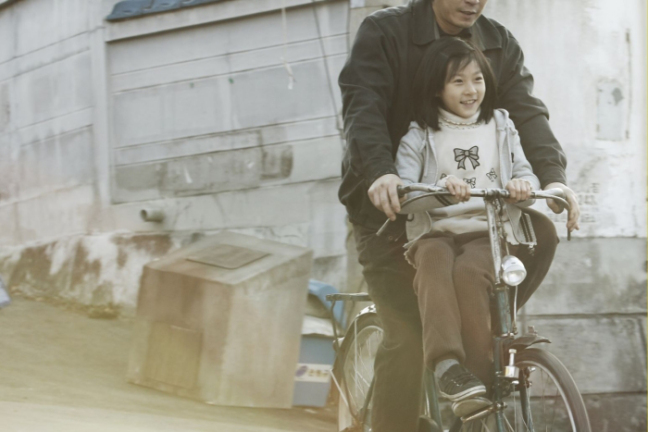 |
Archives
June 2017
Categories
All
|
 RSS Feed