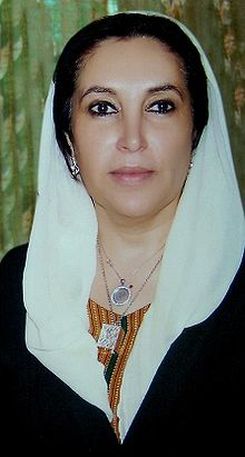
 By Yoon Joung Lee
A Pakistani democratic socialist and the 11th Prime Minister of Pakistan, Benazir Bhutto, was born in the Karachi Dominion of Pakistan in 1953. Her father, Zulfikar Ali Bhutto, was a former prime minister from 1973 to 1977. She was the oldest child out of four in her family. Including her father and Bhutto, two of her brothers were in politics. However, all of them died violently in the end while demonstrating how dangerous the game of Pakistani politics is. Ever since Bhutto was young, her family expected so much from her as their eldest child. Her parents were very supportive for her education, regardless of her gender. She was raised to speak both English and Urdu, and English was her first language. When she was sixteen in 1969, she left Pakistan to study her for her undergraduate degree at Harvard University’s Radcliffe College. After her undergraduate degree, she joined Oxford University in 1973 and completed her Master’s level degree. There, she studied a wide variety of courses- international law, diplomacy, economics, philosophy and politics. After four years of her study in England in 1977, Bhutto had to return back to Pakistan because the military government of General Zia Ul Haq imprisoned her father and seized power. Eventually her father was sentenced to death by hanging. They were not even able to bury her father’s dead body because Bhutto, her mother and brothers also spent the next six and a half years in jail. During their jail time, Bhutto had developed an inner ear problem that required surgery, and her mother was diagnosed with lung cancer. International pressure led Zia to allow them to leave Pakistan to receive medical care. In 1984, Bhutto and her mother settled in London after their release. As soon as their health issues were remedied, Bhutto began to publicly advocate against the Zia regime. In 1986, she returned to Pakistan to call for the resignation of Zia Ul Haq, who executed her father. While she was in Pakistan, she was elected co-chairwoman of the Pakistan People’s Party (PPP) along with her mother. In 1988, General Muhammad Zia Ul Haq unexpectedly died by the airplane crash. The airplane carried several of his top military commanders and US Ambassador to Pakistan, Arnold Lewis Raphel. There was never a definitive cause for the crash found. In that same year, Bhutto lead the PPP to victory in the parliamentary elections, and became the eleventh Prime Minister at her age of thirty five. She was one of the youngest chief executives in the world, and the first female to serve as prime minister to lead a Muslim nation in the modern age. During her first term, she focused on economic uplift of the masses by starting the Peoples’ Program. However, her first term only lasted for two years as the President Ghulam Ishaq Khan dismissed her from office due to various issues, including differences between her Government and the Establishment. In 1993, she was re-elected as Prime Minister by the largest share in Pakistani history with 86 seats and formed a new Government. This time, she put hunger, housing and health care as her top priorities. She also built schools all over the country and brought electricity to the countryside. However, again her own-nominated President, Farooq Ahmad Khan Leghari, dismissed her government in 1996 on corruption charges. She was forced to leave her homeland. Her family lived in exile in London for nine years. When she was able to come back to their native country, her motorcade was attacked by a suicide bomber. Although 100 bystanders died in the attack, she survived this first assassination attempt. In 2008 with national elections scheduled, Bhutto was again attacked by a gunman who fired at her car before detonating a bomb. She was rushed to the hospital but died at Rawalpindi General Hospital during the long surgery. 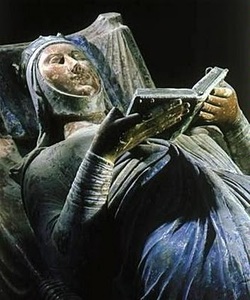 Eleanor of Aquitaine. Tomb effigy at Fontevrault. Eleanor of Aquitaine. Tomb effigy at Fontevrault. By Yoon Joung Lee Eleanor of Aquitaine, renowned for her outstanding beauty and wealth, was born on 1122 in Bordeaux in the region of Aquitaine; as the oldest of three children, to her father, William X, Duke of Aquitaine and her mother, Aenor de Chatellerault. Eleanor grew into a woman of great strength and intelligence. When she was fifteen in 1137, she inherited her father’s land as her father died in that same year. Just a few months after her father’s death, she married Louis, heir to the throne of France. Her husband ruled as king when his father died less than a month later. Eleanor was anointed a Queen. They had two daughters, Marie and Alix. With her strength and courage, she accompanied her husband on the Second Crusade with thousands of knights and three hundred attendant ladies. On the voyage to the Second Crusade, Louis and Eleanor decided to separate and publicly acknowledge their marriage had failed. Even the Pope intervened to heal their relationship, but it was not possible and the marriage was annulled. It’s still not clear but many people assume that the main cause of their separation is the fact that they had no son as their next heir. In 1152, she married Henry FitzEmpress, Duke of Normandy and heir to the throne of England. It was one of the most powerful unions in European history. Two years later, Henry was anointed King Henry ll of England at Westminster Abbey. Aquitaine then became part of the Plantagenet Empire. Eleanor also got her second chance to be Queen. Although Henry was eleven years younger than her, the age didn’t limit her love. With Henry, she was finally satisfied and began to be actively involved in creating the powerful dynasty. Henry and Eleanor had eight children, five sons and three daughters. Including her 2 children with Louis, Eleanor had a total of ten children. When she gave birth to her youngest son, John, she was forty five years old. Unfortunately Eleanor’s first two sons died in infancy and her 3rd son, Richard the Lionheart, became a troubadour, courtier, famous crusader and eventually King of England and Duke of Aquitaine by his mother’s lead. Her husband Henry spent most of his time away to defend his territories and Eleanor spent much of her time with her beloved children and grandchildren, arranging them marriages. With her efforts, she made Aquitaine English crown lands until The Hundred Years War (1337), when French nobility battled for control over the region and won. In 1189, her son Richard became the King as Henry died. But Richard the Lionheart only sat at the King’s position for the next ten years and died by a stray arrow wound in 1199. He was buried next to his father. His brother John took over Richard’s place. The heartbroken mother lived only five more years and died at her age of eighty-two in 1204. Eleanor of Aquitaine was, without doubt, one of the most colorful and powerful Queens in history. |
Archives
July 2017
Categories
All
|
 RSS Feed