 by Yoon Joung Lee
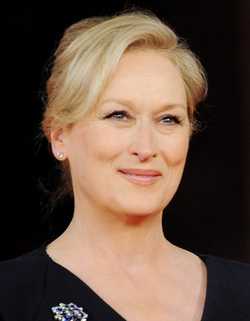
American actress, Merly Streep, was born Mary Louise Streep in 1949 in Summit, New Jersey. She spent her childhood in Bernardsville, New Jersey as the oldest sibling ahead of two older brothers, Harry and Dana. From her young age, she was extremely interested in music, taking opera singing lessons from a renowned coach. When she went to high school, she took acting classes and acting became her dominant interest. In 1971, she received her B.A, in Drama/Acting at Vassar College. She later attended Yale School of Drama and earned her degree in Drama. After graduating from the Yale School of Drama, she moved to New York and performed in several theater productions including the New York Shakespeare Festival productions of Henry V, The Taming of the Shrew with Raul Julia, and Measure for Measure opposite Sam Waterston and John Cazale. She also starred on Broadway show, Happy End, the Brecht/Weill musical. In 1976, she starred on Tennessee Williams’ 27 Wagons Full of Cotton and Arthur Miller’s A Memory of Two Mondays. Her performance brought her a Tony Award nomination for Best Featured Actress in a Play. Later, she also received Drama Desk Award nominations for her two Broadway shows, Anton Chekhov’s The Cherry Orchard and the Bertolt Brecht-Kurt Weill musical Happy End. Because her outstanding theater work caught people’s attention, she began auditioning for film roles. In 1977, she made her first feature film debut on Julia as the high society friend of Jane Fonda’s Lillian Hellman. In 1978, she played a leading role in NB C miniseries TV show Holocaust, a well-to-do German woman trying to save her Jewish husband from the Nazi concentration camp. With this show, she was brought a degree of public recognition and she won a leading actress Emmy. In 1978, she fell in love with the film, The Deer Hunter’s co-star, John Cazale. But she soon found out he had bone cancer. She nursed him until his death on March 12, 1978. After The Deer Hunter was released, she was nominated for the Academy Award for Best Supporting Actress for her performance. In 1979, she was on Kramer vs. Kramer which she played a role of a woman who abandons her family to come back and fight for custody of her son. This role brought her first Academy Award for Best Supporting Actress. During the 1980s, she spent her much of time trying various roles. In 1982 in Sophie’s Choice, she played Sophie Zawistowski who is a Brooklyn-based concentration camp survivor traumatized by her experiences during the Holocaust. For her role in Sophie’s Choice, she won her second Academy Award, this time for Best Actress. In Out of Africa in 1985, she won another Academy Award nomination with her role as a Danish plantation owner living in Kenya. During 1990s, she was awarded Academy Awards for several films including Postcards from the Edge and The Bridges of Madison County as she begun playing challenging roles, many Hollywood actresses have struggled. She was nominated for Academy Award with two films, The Hours and Adaptation in 2002. In 2003, she won her second Emmy Award for her work on Angels in America. Her later roles in The Manchurian Candidate (2004) and Prime (2005) showed her comic skills. In 2006, she played the inimitable magazine editor in The Devil Wears Prada and earned Academy Award, SAG and Golden Globe nominations for Best Actress. That same year, she also played characters related to music. She was cast as country music singer, Yolanda Johnson in the film A Prairie Home Companion. In 2008, she again played a musical role in Mamma Mia, the film adaptation of the ABBA musical. With the film Doubt, she won various awards including Academy Award, Golden Globe nominations and a SAG award for Best Actress. Also, with her next project, Julie & Julia, which she played the famous chef, she won the Golden Globe Award for Best Actress. She soon earned another Golden Globe nod with her romantic comedy film It’s Complicated. In 2011, she played a role of former British prime minister Margaret Thatcher in The Iron Lady which brought her several awards including a Golden Globe and an Oscar for Best Actress. She has been married to sculptor Don Gummer since 1978. She is a mother of four adult children. 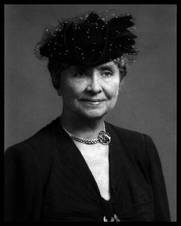 Yoon Joung Lee An American author, political activist and lecturer, Helen Adams Keller was born in 1880 in Tuscumbia, Alabama. She was the first of two daughter born to Arthur H. Keller and Katherine Adams Keller. Her family was not affluent and earned a living income from their cotton plantation. When she was 19 months old, she contracted an illness and was struck blind, deaf and mute. Doctors described her condition as “brain fever” that produces high body temperatures. After the illness her family noticed she couldn’t hear when the dinner bell was rung, and she didn’t see when someone waved their hands in front of her face. The illness went away shortly but it left her deaf and blind. Though, she was intelligent, she could not communicate nor receive information from the world around her. She grew wild and threw fits. While Keller was still a child, her parents were inspired by the story of Charles Dickens’ American Notes about the successful education of another disability woman, Laura Bridgman, who was also deaf and blind. Keller dispatched with her father to seek out Dr. J. Julian Chisolm, an eye, ear, nose and throat specialist in Baltimore. There, by his help Keller and her father was put in touch with Alexander Graham Bell who was an inventor of telephone and also was working with deaf children at the time. Bell introduced them to contact the Perkins Institute for the Blind, the school where Laura Bridgman had been educated. The director of the school called their most recent graduate, Anne Sullivan who was only 20 years old at that time, and she became Keller’s teacher. In 1887, Anne Sullivan went to Helen Keller’s home in Alabama and immediately began to teach Keller finger spelling. The first word she taught Keller was the word “doll.” To let her understand the word, she brought a doll as Keller’s gift, who at first was curious, interested and then defiant. As Keller often refused her instruction and Keller’s frustration grew, Sullivan suggested that she and Keller move away from the family for a while, so that Keller can concentrate only on Sullivan’s instruction. It wasn’t easy process even after they moved to a cottage on the plantation. They were still in a dramatic struggle, but Keller started to make the connection between the object and letters. When she learned the word “ water”, Sullivan went out with Keller and placed her hand under the spout in the water pump or flushed cool water over her hand. Keller understood and repeated the word in Sullivan’s hand. In 1888, Keller attended the Perkins institute for the Blind. In 1894, Keller moved to New York to attend the Wright-Humason School for the Deaf with Sullivan. In 1896, she attended The Cambridge School for Young Ladies. In 1900, she attended Radcliffe College and and became the first deaf-blind person to earn a Bachelor of Arts degree in 1904. During this long period, Sullivan always accompanied with Keller. In 1905, Sullivan married John Macy, an instructor at Harvard University, a social critic, and a prominent socialist. But their marriage gradually failed due to Sullivan’s devotion to Keller. They didn’t divorce but they were separated, and Sullivan’s health started failing around 1914. By the time, Helen Keller already became a well-known celebrity and lecturer by encouraging disabilities over the world with sharing her experiences. In 1920, she co-founded the American Civil Liberties Union (ACLU) with renowned city planner George Kessler. She also became a member for the American Federation for the Blind in 1924. There, she participated in numerous campaigns to raise awareness, money and support for people in disabilities. Keller’s mentor and a long-time companion, Anne Sullivan, died in 1936. Sullivan’s secretary Polly Thompson became her constant companion and they traveled to 35 countries on five continents, raising funds for the blind. In 1946, Keller was appointed counselor on international relations for the American Foundation of Overseas Blind. Her autobiography The Story of My Life was aired on TV as the title “The Miracle Worker” in 1957, and the story was also played on Broadway. In 1961, she spent the rest of her life at her home in Connecticut because she suffered from a series of stokes. Helen Keller died in 1968 during her sleep only few weeks before her 88th birthday. During her remarkable lifetime, she received many awards. In 1936, she received the Theodore Roosevelt Distinguished Service Medal. In 1964, she awarded the Presidential Medal of Freedom. In 1965, she was elected to the Women’s Hall of Fame. She also received honorary doctoral degrees from Temple University, Harvard University, and universities of Glasgow, Scotland, Delhi, Germany, Berlin and India. Even though she couldn’t hear and see how huge her impact was for many disabilities over the world, she was one of the most powerful examples of our history. By overcoming her difficult conditions, she demonstrated how hard work, imagination, and determination allow an individual to triumph over adversity. 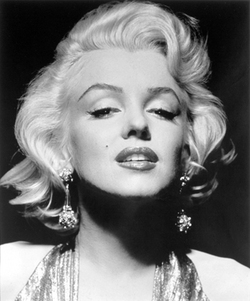 By Yoon Joung Lee
Marilyn Monroe was born in 1926 in Los Angeles General Hospital. She was born as Norma Jeane Mortenson. Her mother had married a Martin E. Mortensen in 1924, but divorced when she was pregnant. Since her mother misspelled her father’s name on her birth certificate, she never knew who her father was. During her childhood, she frequently stayed at a family friend’s or at orphanages due to her mother’s mental illness. Her first modeling was on one of Blue Book, appearing on dozens of magazines covers. Those modeling photos captivated people’s attention and brought her to a screen test with 20th Century Fox. The executives, directors and photographers immediately recognized her potential and ability. She quickly became a “photographers dream” and Marilyn Monroe with a platinum shade of blonde was newly born in 1946. In 1947 she played an uncredited role as a telephone operator in “The Shocking Miss Pilgrim.” The same year, she won several brief roles in “Dangerous Years,” “Green Grass of Wyoming,” and “You Were Meant for Me.” Her contract with 20 Century Fox ended in late 1947. She signed a 6 month contract with Columbia Pictures. There, she met her drama coach, Natasha Lytess and she was Monroe’s acting coach for several years. In 1948 Monroe starred in the low-budget musical, “Ladies of the Chorus.” She sang the first song, but the movie didn’t bring any success. In 1950, she played her first serious acting job as the young mistress of an aging criminal in “The Asphalt Jungle”. She earned many favorable reviews from movie experts and the public. Her works “Clash By Night” and “Don’t Bother to Knock” in 1952, both earned favorable notices. The same year, she also filmed “Niagara” with Joseph Cotten and this movie made her a superstar. The year of 1952 was a special year for her because she met several crucial roles establishing her stardom, and she met her romantic partner, Joe Dimaggio who had recently retired from baseball. In 1954 Joe and Monroe married and their wedding news was announced in many different media over the world. However, their marriage did not last too long. Joe did not want her to work as an actress, he wanted her to stay home, be a housewife, not be a star of such magnitude. They separated in late 1954 and divorced later. In 1954, she appeared in the musical “There’s No Business Like Show Business.” But the show was not successful. During this summer, she suffered from bronchitis and anemia. She also showed serious side-effects from sleeping pills she had been taking for the past few years. In September 1954, her most notable film roles, a skirt-blowing key scene for, “The Seven Year Itch” was shot on Lexington Avenue in New York City. About several thousand people including her fans and photographers gathered outside to see and record her. With her growing fame as a sex symbol, her private life was a matter of public and intense media scrutiny, and she suffered from fragile health and emotional problems. She gradually was late, unprepared and unstable at work after the failure of her third marriage. In 1962, she was found dead in her Brentwood home and an investigation announced her death caused by an overdose of medication. Marilyn Monroe’s career as an actress lasted for 16 years and she was on 29 films. Although she died many decades ago, her images are everywhere and she is still famous currently as she was named the sixth greatest female star of all time in the American Film institute’s list of 100. Monroe and her life story represents the image of Hollywood and its glory and fame. |
Archives
July 2017
Categories
All
|
 RSS Feed