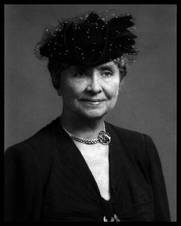
 Yoon Joung Lee An American author, political activist and lecturer, Helen Adams Keller was born in 1880 in Tuscumbia, Alabama. She was the first of two daughter born to Arthur H. Keller and Katherine Adams Keller. Her family was not affluent and earned a living income from their cotton plantation. When she was 19 months old, she contracted an illness and was struck blind, deaf and mute. Doctors described her condition as “brain fever” that produces high body temperatures. After the illness her family noticed she couldn’t hear when the dinner bell was rung, and she didn’t see when someone waved their hands in front of her face. The illness went away shortly but it left her deaf and blind. Though, she was intelligent, she could not communicate nor receive information from the world around her. She grew wild and threw fits. While Keller was still a child, her parents were inspired by the story of Charles Dickens’ American Notes about the successful education of another disability woman, Laura Bridgman, who was also deaf and blind. Keller dispatched with her father to seek out Dr. J. Julian Chisolm, an eye, ear, nose and throat specialist in Baltimore. There, by his help Keller and her father was put in touch with Alexander Graham Bell who was an inventor of telephone and also was working with deaf children at the time. Bell introduced them to contact the Perkins Institute for the Blind, the school where Laura Bridgman had been educated. The director of the school called their most recent graduate, Anne Sullivan who was only 20 years old at that time, and she became Keller’s teacher. In 1887, Anne Sullivan went to Helen Keller’s home in Alabama and immediately began to teach Keller finger spelling. The first word she taught Keller was the word “doll.” To let her understand the word, she brought a doll as Keller’s gift, who at first was curious, interested and then defiant. As Keller often refused her instruction and Keller’s frustration grew, Sullivan suggested that she and Keller move away from the family for a while, so that Keller can concentrate only on Sullivan’s instruction. It wasn’t easy process even after they moved to a cottage on the plantation. They were still in a dramatic struggle, but Keller started to make the connection between the object and letters. When she learned the word “ water”, Sullivan went out with Keller and placed her hand under the spout in the water pump or flushed cool water over her hand. Keller understood and repeated the word in Sullivan’s hand. In 1888, Keller attended the Perkins institute for the Blind. In 1894, Keller moved to New York to attend the Wright-Humason School for the Deaf with Sullivan. In 1896, she attended The Cambridge School for Young Ladies. In 1900, she attended Radcliffe College and and became the first deaf-blind person to earn a Bachelor of Arts degree in 1904. During this long period, Sullivan always accompanied with Keller. In 1905, Sullivan married John Macy, an instructor at Harvard University, a social critic, and a prominent socialist. But their marriage gradually failed due to Sullivan’s devotion to Keller. They didn’t divorce but they were separated, and Sullivan’s health started failing around 1914. By the time, Helen Keller already became a well-known celebrity and lecturer by encouraging disabilities over the world with sharing her experiences. In 1920, she co-founded the American Civil Liberties Union (ACLU) with renowned city planner George Kessler. She also became a member for the American Federation for the Blind in 1924. There, she participated in numerous campaigns to raise awareness, money and support for people in disabilities. Keller’s mentor and a long-time companion, Anne Sullivan, died in 1936. Sullivan’s secretary Polly Thompson became her constant companion and they traveled to 35 countries on five continents, raising funds for the blind. In 1946, Keller was appointed counselor on international relations for the American Foundation of Overseas Blind. Her autobiography The Story of My Life was aired on TV as the title “The Miracle Worker” in 1957, and the story was also played on Broadway. In 1961, she spent the rest of her life at her home in Connecticut because she suffered from a series of stokes. Helen Keller died in 1968 during her sleep only few weeks before her 88th birthday. During her remarkable lifetime, she received many awards. In 1936, she received the Theodore Roosevelt Distinguished Service Medal. In 1964, she awarded the Presidential Medal of Freedom. In 1965, she was elected to the Women’s Hall of Fame. She also received honorary doctoral degrees from Temple University, Harvard University, and universities of Glasgow, Scotland, Delhi, Germany, Berlin and India. Even though she couldn’t hear and see how huge her impact was for many disabilities over the world, she was one of the most powerful examples of our history. By overcoming her difficult conditions, she demonstrated how hard work, imagination, and determination allow an individual to triumph over adversity. Comments are closed.
|
Archives
July 2017
Categories
All
|
 RSS Feed